

Quick Answer
Dog anxiety at night typically stems from separation anxiety, lack of physical exercise, disrupted routine, age-related cognitive decline, or underlying medical conditions. Most dogs find relief through consistent bedtime routines, adequate daytime exercise, creating a comfortable sleep environment, and using calming techniques like white noise or comfort items. If nighttime anxiety persists beyond two weeks or worsens, consult your veterinarian to rule out medical issues and discuss behavioral modification strategies.
This article provides educational information about dog anxiety and general wellness strategies. It is not a substitute for professional veterinary care. If your dog shows sudden behavioral changes, signs of pain or illness, or severe anxiety symptoms, consult your veterinarian. Every dog is unique, and professional guidance ensures the best approach for your individual pet’s needs.
A Story That Started at 2 AM
Sarah Mitchell remembers the exact moment she realized her three-year-old Golden Retriever, Bailey, wasn’t just having a bad night. It was 2:17 AM when she woke to find Bailey pacing circles in the hallway, panting heavily despite the cool bedroom temperature. This wasn’t the first night—it was the seventh consecutive night of disrupted sleep for both of them.
“I felt helpless,” Sarah recalls. “During the day, Bailey was the happy, energetic dog I’d always known. But as soon as the sun went down, something changed. The pacing, the whining, the constant need to check on me—it was heartbreaking to watch.”
Sarah’s experience mirrors what thousands of dog owners face each night. Understanding why dogs experience nighttime anxiety and how to address it can transform both your life and your dog’s wellbeing. This comprehensive guide will walk you through everything you need to know about dog anxiety at night, from identifying the root causes to implementing effective solutions.
Understanding Nighttime Dog Anxiety: What’s Really Happening
Why Is My Dog Anxious at Night?
Nighttime dog anxiety isn’t random—it’s your dog’s way of communicating that something feels wrong or unsafe. According to research from the American Veterinary Medical Association, approximately 20-40% of dogs experience some form of anxiety disorder, with nighttime symptoms being particularly common.
Dogs are naturally den animals with deeply ingrained survival instincts. When darkness falls, these instincts can intensify, especially if your dog feels vulnerable, isolated, or senses changes in the household environment.
The transition from day to night represents more than just reduced light. For dogs, nighttime brings:
Decreased household activity and interaction, which can trigger separation concerns. The sudden quiet after a busy day may feel isolating to dogs who thrive on companionship.
Changes in sensory input as visual cues diminish and auditory and olfactory senses heighten. Dogs may become hyper-aware of sounds they filtered out during the day.
Shifts in routine that signal extended periods without attention, food, or bathroom breaks. This predictability can actually cause anxiety in dogs who struggle with waiting.

The Root Causes of Dog Anxiety at Night
Medical Conditions That Trigger Nighttime Anxiety
Before addressing behavioral causes, it’s crucial to rule out underlying medical issues. The Cornell University College of Veterinary Medicine emphasizes that many anxiety-like symptoms actually stem from physical discomfort or illness.
Common medical triggers include:
- Cognitive Dysfunction Syndrome (CDS): Similar to dementia in humans, CDS affects senior dogs and often worsens at night, a phenomenon known as “sundowning”
- Thyroid imbalances: Hyperthyroidism can cause restlessness, increased heart rate, and anxiety symptoms
- Chronic pain conditions: Arthritis, hip dysplasia, or other painful conditions may intensify when dogs lie down
- Gastrointestinal distress: Acid reflux, nausea, or digestive issues can prevent comfortable rest
- Urinary tract infections or incontinence: The urgent need to eliminate can cause significant distress
- Vision or hearing loss: Sensory decline can make nighttime particularly disorienting and frightening
Sarah discovered Bailey’s anxiety actually began after a minor ear infection. “The vet explained that the residual inflammation was causing discomfort when she laid her head down. Once we addressed that, about 40% of her anxiety symptoms improved.”
If your dog shows sudden behavioral changes or displays physical symptoms alongside anxiety, schedule a veterinary appointment to rule out medical causes.
Behavioral and Environmental Factors
When medical causes are ruled out, behavioral and environmental factors become the focus. Research published by the National Institutes of Health identifies several key behavioral contributors to nighttime anxiety in dogs.
Separation anxiety remains the leading behavioral cause. Dogs with separation anxiety experience distress when apart from their primary caregiver, and nighttime represents the longest separation period. These dogs may have experienced early-life trauma, rehoming, or inconsistent caregiving.
Not sure if your dog has separation anxiety? Our guide Does My Dog Have Separation Anxiety? (Quiz + Expert Signs) can help you identify the specific symptoms and differentiate between separation anxiety and other behavioral issues.
Insufficient physical and mental stimulation during the day leaves dogs with excess energy and unmet needs. A dog who hasn’t adequately exercised may feel restless and unable to settle at night. The American Kennel Club recommends breed-appropriate exercise levels, noting that many behavioral issues stem from under-stimulation.
Disrupted or inconsistent routines create uncertainty. Dogs thrive on predictability, and irregular bedtimes, feeding schedules, or evening activities can generate anxiety about what comes next.
Environmental stressors include new sounds (construction, neighbors, wildlife), changes in household dynamics (new baby, guests, moving), temperature discomfort, or insufficient darkness or light in the sleeping area.
Learned behaviors can also perpetuate nighttime anxiety. If a dog receives attention, treats, or extra privileges when showing anxious behaviors at night, they may continue these behaviors to achieve the same outcome.

Recognizing the Signs: Is Your Dog Actually Anxious?
Physical and Behavioral Symptoms
Understanding the difference between normal nighttime behavior and true anxiety helps you respond appropriately. The American Animal Hospital Association provides comprehensive guidelines for identifying anxiety symptoms in companion animals.
Physical signs of nighttime dog anxiety:
- Excessive panting or drooling when temperature is comfortable
- Trembling, shaking, or muscle tension
- Dilated pupils or “whale eye” (showing whites of eyes)
- Tucked tail, lowered body posture, or pinned-back ears
- Excessive yawning, lip licking, or other stress signals
- Increased heart rate (you may notice rapid chest movement)
- Loss of appetite or refusing bedtime treats
- Digestive upset, including diarrhea or vomiting
Behavioral signs include:
- Pacing, circling, or inability to settle in one location
- Whining, barking, howling, or other vocalizations
- Destructive behavior (chewing, scratching doors/walls)
- Attempting to hide in closets, under beds, or behind furniture
- Following owners from room to room
- Refusing to enter bedroom or sleeping area
- Excessive clinginess or attention-seeking
- House soiling despite being house-trained
- Excessive grooming or self-soothing behaviors
Bailey exhibited several classic signs. “She would pace for 10-15 minutes, then lay down for two minutes, then get up and pace again,” Sarah explains. “Her breathing was fast, and she kept looking at me with these worried eyes, like she needed reassurance that everything was okay.”
When Normal Becomes a Problem
Not every nighttime disturbance indicates clinical anxiety. Occasional restlessness, adjustment periods after routine changes, or brief responses to unusual noises are normal. However, anxiety becomes problematic when:
The behaviors occur consistently for more than two weeks, persist despite environmental adjustments, interfere with your dog’s quality of life or your household’s functioning, or escalate in frequency or intensity over time.
If your dog displays concerning symptoms or if anxiety persists beyond two weeks, consult your veterinarian for proper evaluation.
The Science Behind Canine Nighttime Anxiety
How Dogs Process Fear and Anxiety
Understanding the neurological basis of anxiety helps explain why certain interventions work. Research from Tufts University Cummings School of Veterinary Medicine reveals that dogs’ anxiety responses involve complex interactions between brain structure, neurotransmitters, and learned associations.
When dogs perceive a threat—real or imagined—their amygdala (the brain’s fear center) triggers a cascade of stress responses. The hypothalamic-pituitary-adrenal (HPA) axis activates, releasing cortisol and adrenaline. These stress hormones prepare the body for “fight or flight.”
In dogs with anxiety disorders, this system becomes dysregulated. The brain may perceive routine nighttime events as threats, triggering inappropriate fear responses. Over time, these patterns become entrenched, creating a cycle where nighttime itself becomes a conditioned trigger for anxiety.

Age-Related Considerations
Puppies and young dogs may experience nighttime anxiety due to:
- Incomplete house-training creating elimination urgency
- Fear of isolation after recently leaving littermates
- Developmental fear periods (around 8-10 weeks and 6-14 months)
- Insufficient crate training or negative associations with sleeping areas
Adult dogs typically develop nighttime anxiety from:
- Life changes (moving, new family member, loss of companion)
- Traumatic experiences or learned fears
- Insufficient exercise or mental stimulation
- Underlying medical conditions beginning to emerge
Senior dogs face unique challenges:
- Cognitive dysfunction syndrome affecting up to 68% of dogs over 15 years old
- Increased pain from arthritis or other age-related conditions
- Sensory decline creating disorientation
- Changes in sleep-wake cycles
Comprehensive Solutions for Dog Anxiety at Night
Step 1: Establish a Consistent Evening Routine
Creating predictability is foundational to reducing nighttime anxiety. Dogs find comfort in routine because it removes uncertainty about what happens next.
Your evening routine should include:
6:00-7:00 PM – Final meal: Feed dinner at the same time daily. Consistency helps regulate digestion and elimination schedules.
7:30 PM – Active exercise: Engage in 30-60 minutes of physical activity appropriate for your dog’s age and fitness level. This might include brisk walking, fetch, swimming, or structured play. Exercise depletes excess energy and promotes natural tiredness.
8:00 PM – Mental enrichment: Provide 15-20 minutes of training, puzzle toys, or scent work. Mental stimulation is as tiring as physical exercise and helps your dog achieve a satisfied, content state.
8:30 PM – Final bathroom break: Take your dog outside for elimination. Use the same location and allow adequate time for complete elimination.
9:00 PM – Wind-down period: Transition to calm activities. This might include gentle petting, grooming, or simply sitting together while you read or watch television quietly. Dim household lights to signal the approaching sleep period.
9:30 PM – Bedtime: Guide your dog to their sleeping area with a consistent verbal cue like “bedtime.” Provide a small, easily digestible treat if using food as part of your routine.
“The routine was game-changing for Bailey,” Sarah reports. “It took about 10 days of absolute consistency, but once she learned the pattern, she started naturally settling around 9:15, anticipating bedtime.”

Step 2: Optimize the Sleep Environment
Your dog’s sleeping area significantly impacts their comfort and security. According to guidelines from the University of California, Davis School of Veterinary Medicine, environmental optimization should address temperature, lighting, sound, and comfort.
Location considerations:
Choose a quiet area away from high-traffic zones but not completely isolated. Dogs need to feel part of the household pack. For dogs with separation anxiety, placing their bed in or near your bedroom can provide comfort without reinforcing problematic behaviors. Some dogs benefit from crate training, which provides den-like security.
Comfort elements:
Invest in a high-quality, orthopedic dog bed appropriate for your dog’s size. Ensure adequate cushioning, especially for senior dogs or those with joint issues. Maintain room temperature between 65-75°F (18-24°C), as extreme temperatures disrupt sleep. Provide appropriate bedding—some dogs prefer cozy blankets while others overheat easily.
Sensory management:
Use white noise machines, fans, or calming music designed for dogs to mask sudden sounds. The American Kennel Club notes that specific frequencies can promote relaxation. Maintain consistent, dim lighting. Complete darkness can disorient some dogs, while too much light disrupts sleep cycles. Consider plug-in nightlights for senior dogs with vision impairment.
Scent and familiarity:
Include items with your scent (worn t-shirt) in your dog’s sleeping area. Familiar scents provide comfort during separation. Some dogs benefit from pheromone diffusers, though research shows mixed results and individual responses vary.
Step 3: Address Exercise and Mental Stimulation Needs
Inadequate daily activity remains one of the most overlooked causes of nighttime restlessness. The solution isn’t simply “more exercise” but rather appropriate, well-timed physical and mental stimulation.
Physical exercise guidelines by breed type:
| Breed Category | Daily Exercise Needs | Ideal Activities |
|---|---|---|
| High-energy (Border Collies, Australian Shepherds, Huskies) | 90-120 minutes | Running, agility training, fetch, hiking, swimming |
| Medium-energy (Labrador Retrievers, Golden Retrievers, Boxers) | 60-90 minutes | Brisk walks, fetch, swimming, moderate hiking |
| Low-energy (Bulldogs, Basset Hounds, Shih Tzus) | 30-45 minutes | Leisurely walks, gentle play, short training sessions |
| Senior dogs (varies by health) | 20-40 minutes | Multiple short walks, gentle swimming, sniff walks |
Mental stimulation strategies:
Training sessions (10-15 minutes, 2-3 times daily) teaching new commands or tricks. Puzzle feeders and interactive toys that require problem-solving. Scent work and nose games that engage natural hunting instincts. Food-dispensing toys that extend mealtime and provide challenge. Rotation of toys to maintain novelty and interest.
Important timing note: Avoid intense exercise within 2 hours of bedtime. While exercise is crucial, late-night vigorous activity can be overstimulating. The goal is “pleasantly tired,” not “wound up.”

Step 4: Implement Calming Techniques
Various non-medical interventions can help dogs achieve a calmer state conducive to sleep.
For a comprehensive overview of calming techniques that work during the day and night, see our complete guide: How to Help a Nervous Dog: Complete Guide to Calming Anxious Dogs.
Physical calming methods:
Massage and touch therapy: Gentle, slow stroking along your dog’s body activates the parasympathetic nervous system, promoting relaxation. Focus on areas your dog enjoys—many prefer gentle ear rubs, chest scratches, or slow back strokes. The American Veterinary Medical Association recognizes massage as a beneficial complementary therapy for anxious dogs.
Pressure wraps: Products that apply gentle, constant pressure can have calming effects similar to swaddling in infants. These work by activating pressure points and providing a sense of security. Not all dogs respond positively, so introduction should be gradual and positive.
Environmental calming:
Music and sound therapy: Classical music, reggae, and specially composed pet music have shown positive effects in research studies. Sound therapy works by masking environmental noises and providing predictable, soothing auditory input.
Aromatherapy: Certain scents like lavender may promote relaxation in some dogs, but essential oils must be used cautiously as some are toxic to dogs. Always research safety and use proper dilution if you choose to try aromatherapy.
Behavioral techniques:
Counterconditioning: Gradually change your dog’s emotional response to nighttime by pairing it with positive experiences. This might involve special treats, favorite toys, or engaging activities that only occur during the evening wind-down period.
Desensitization: Systematically expose your dog to anxiety triggers at low intensities while maintaining a calm state, gradually increasing intensity over time. This technique requires patience and consistency but can effectively reduce anxiety responses.
Step 5: Training and Behavior Modification
Addressing nighttime anxiety often requires targeted training to help your dog develop new associations with bedtime and nighttime.
“Place” or “Bed” command training:
Teaching your dog to go to a designated spot on command provides structure and predictability. Start by luring your dog to their bed with treats, marking the behavior with “yes” or a clicker, and rewarding. Practice during the day when anxiety is low. Gradually increase duration before rewarding. Eventually, the bed itself becomes associated with positive experiences and relaxation.
Alone-time training:
For separation-related nighttime anxiety, gradually acclimate your dog to comfortable alone time. Start with very brief separations (30 seconds) during the day while remaining in sight. Gradually increase duration and distance. Reward calm behavior and ignore attention-seeking. The goal is teaching that your absence is temporary and non-threatening.
Relaxation training:
Teach your dog to achieve a relaxed state on cue. Start by capturing naturally calm moments with a marker word like “settle” and a reward. Practice having your dog lie down and remain calm for increasing periods. Eventually, “settle” becomes a cue that helps your dog achieve a relaxed state even in mildly stressful situations.
Bailey’s progress included targeted training. “We practiced the ‘settle’ command throughout the day,” Sarah shares. “By the time we needed it at bedtime, Bailey already understood what I was asking. It gave her a job to do instead of just being anxious.”
Common Mistakes That Worsen Nighttime Dog Anxiety
What Not to Do
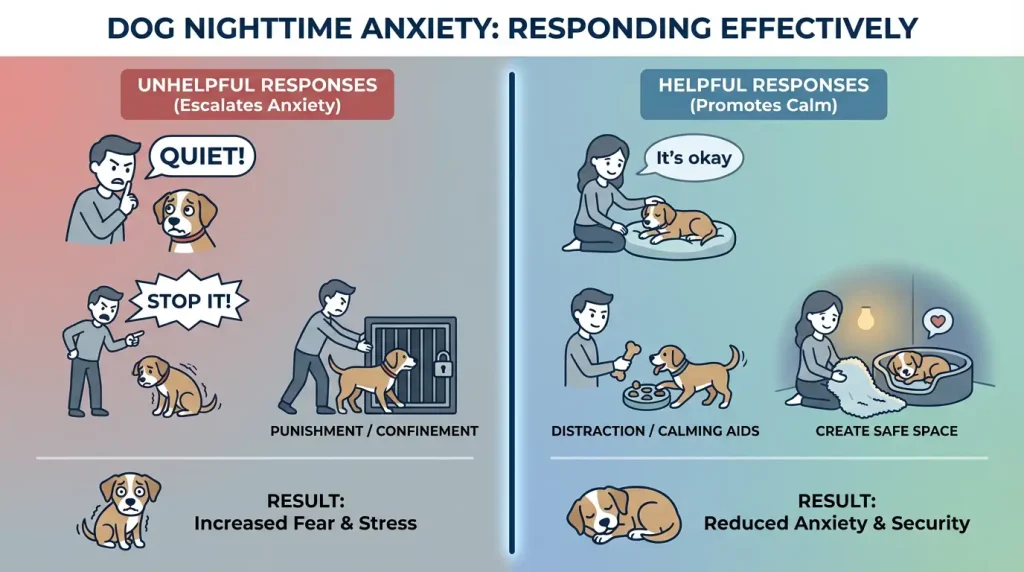
Well-intentioned responses can inadvertently reinforce or worsen anxiety behaviors. Understanding these common mistakes helps you avoid counterproductive patterns.
Mistake #1: Providing attention during anxious episodes
When your dog whines, barks, or shows distress at night, the natural impulse is to provide comfort. However, if you respond with attention, petting, or soothing words every time your dog displays anxiety, you may inadvertently reinforce the behavior. Your dog learns that anxious behavior produces the desired outcome—your attention.
Better approach: Ignore attention-seeking behaviors while rewarding calm, quiet behavior. This doesn’t mean ignoring genuine distress, but rather differentiating between anxiety behaviors and manipulative attention-seeking.
Mistake #2: Inconsistent routines and responses
Allowing your dog to sleep in your bed some nights but not others, having different bedtimes on weekends versus weekdays, or having different family members enforce different rules creates confusion and uncertainty—both anxiety triggers.
Better approach: Establish rules and stick to them every day, regardless of circumstances. Consistency is crucial for anxious dogs.
Mistake #3: Insufficient daytime exercise
Hoping your dog will “just settle down” without adequate physical and mental stimulation sets both of you up for failure. An understimulated dog will struggle to relax regardless of other interventions.
Better approach: Meet your dog’s exercise needs before implementing other strategies. Think of exercise as the foundation upon which all other interventions build.
Mistake #4: Punishing anxious behavior
Scolding, yelling, or punishing a dog for anxiety behaviors increases fear and worsens the problem. Anxiety isn’t willful disobedience—it’s a genuine emotional response your dog can’t control without help.
Better approach: Address the underlying cause of anxiety rather than punishing its expression. Focus on creating positive associations with nighttime.
Mistake #5: Skipping veterinary consultation
Attempting to solve nighttime anxiety without ruling out medical causes can lead to months of unsuccessful behavioral interventions while an underlying condition goes untreated.
Better approach: Always begin with a comprehensive veterinary examination to rule out pain, illness, or cognitive dysfunction.
Mistake #6: Abrupt changes
Suddenly moving your dog’s sleeping location, drastically changing evening routines, or implementing multiple interventions simultaneously can overwhelm an already anxious dog.
Better approach: Make gradual changes, implementing one modification at a time. This allows you to identify what works and gives your dog time to adjust.
Advanced Strategies for Persistent Nighttime Anxiety
When Basic Interventions Aren’t Enough
For dogs whose anxiety doesn’t respond adequately to routine optimization and basic calming techniques, advanced strategies may be necessary.
Certified behavior consultant intervention:
Professional animal behaviorists or veterinary behaviorists specialize in complex anxiety cases. They can develop customized behavior modification plans, identify subtle triggers you might miss, and provide ongoing support and adjustment of strategies.
These professionals use evidence-based approaches including systematic desensitization, counterconditioning protocols, and functional analysis of behavior. The American College of Veterinary Behaviorists provides resources for finding qualified professionals.
Alternative therapies:
Several complementary approaches show promise for anxious dogs, though research quality and individual responses vary.
Canine massage therapy: Certified canine massage therapists can identify and address physical tension patterns that contribute to anxiety. Regular sessions may help dogs achieve deeper relaxation.
Acupuncture: Some veterinarians report success using acupuncture for anxiety management. Research from veterinary institutions suggests potential benefits through endorphin release and nervous system regulation.
Structured training programs:
Formal programs like “Relaxation Protocol” or “Control Unleashed” provide systematic approaches to teaching dogs emotional regulation skills. These programs typically involve daily training sessions over several weeks or months.
Technology-Assisted Solutions
Modern technology offers new tools for managing canine anxiety:
Pet cameras with two-way audio: These allow you to monitor your dog’s nighttime behavior and provide occasional verbal reassurance without entering the room. They help you understand what’s happening during anxious episodes and track progress over time.
Activity monitors: Wearable devices track sleep patterns, activity levels, and even vital signs. Data can help identify patterns—for example, discovering that anxiety correlates with insufficient daytime exercise or occurs at specific times.
Automated comfort devices: Heartbeat simulators, automated treat dispensers triggered by calm behavior, and robotic companions designed for anxious dogs may provide comfort for some individuals.
Age-Specific Approaches to Nighttime Anxiety
Puppies and Young Dogs
Nighttime anxiety in puppies often stems from sudden separation from littermates and adjustment to a new environment. Young dogs need different approaches than adults.
Crate training for security:
A properly introduced crate becomes a safe den. Place the crate in your bedroom initially so the puppy feels near you. Cover three sides to create a den-like atmosphere. Use positive associations—feed meals in the crate, provide special toys only available in the crate. Never use the crate for punishment.
Gradual independence building:
Start with the crate directly beside your bed. After several nights of calm sleeping, move the crate a few feet away. Continue this gradual process over weeks, eventually moving the crate to its permanent location. Some dogs always prefer sleeping in the owner’s bedroom—this is a personal decision and doesn’t indicate failure if it works for your household.
Scheduled nighttime bathroom breaks:
Young puppies lack bladder control for overnight periods. Expect to wake once or twice for bathroom breaks initially. Set alarms rather than waiting for crying to avoid reinforcing vocalization. Gradually extend time between nighttime breaks as your puppy matures.
Senior Dogs and Cognitive Dysfunction
Older dogs experiencing nighttime anxiety require special consideration, particularly when cognitive dysfunction syndrome (CDS) is involved.
Environmental modifications for cognitive decline:
Increase lighting to compensate for vision changes. Senior dogs may become disoriented in complete darkness. Use nightlights in hallways and sleeping areas. Remove obstacles that could cause confusion or injury during nighttime wandering. Keep furniture in consistent locations to aid navigation.
Adjusted expectations:
Senior dogs with CDS may experience confusion, disorientation, and distress that doesn’t respond to typical behavioral interventions. The goal shifts from eliminating nighttime disturbances to minimizing distress and maintaining quality of life. Your veterinarian can recommend specific management strategies for CDS.
Comfort and accessibility:
Senior dogs may need easier bathroom access. Consider puppy pads or a designated indoor elimination area if getting outside is difficult. Provide extra comfort—orthopedic bedding, heating pads (used safely), and easy access to water. Monitor for pain signs, as discomfort intensifies at night when distractions are minimal.
When to Seek Professional Help
Red Flags Requiring Veterinary Attention
Certain situations warrant immediate professional consultation rather than attempting home management.
Seek veterinary care if your dog:
- Displays sudden onset of anxiety with no obvious trigger
- Shows anxiety symptoms alongside physical signs like vomiting, diarrhea, excessive thirst, or changes in appetite
- Exhibits self-harming behaviors like excessive licking, chewing, or scratching
- Has anxiety that progressively worsens despite interventions
- Displays aggression related to nighttime anxiety
- Is a senior dog with new or changing nighttime behaviors
- Cannot settle even briefly, maintaining constant agitation for hours
- Has anxiety that severely impacts quality of life for the dog or household
The veterinary visit:
Prepare for your appointment by documenting symptoms. Keep a journal for at least one week noting when anxiety occurs, what behaviors you observe, duration of episodes, potential triggers, and what (if anything) helps. Video recordings of anxious episodes can be incredibly helpful for veterinarians.
Your veterinarian will likely perform a comprehensive physical examination, blood work to check for thyroid function and other markers, and potentially additional diagnostic tests based on findings. For senior dogs, cognitive function assessment may be included.
Finding Qualified Behavior Professionals
If medical causes are ruled out but anxiety persists, a certified behavior professional can provide specialized help.
Credentials to look for:
Veterinary Behaviorist (DACVB): Veterinarians with advanced training in animal behavior who have passed rigorous board certification. They can prescribe behavioral modification protocols and discuss appropriate intervention options.
Certified Applied Animal Behaviorist (CAAB): Professionals with graduate degrees in animal behavior who have met certification requirements through the Animal Behavior Society.
Certified Professional Dog Trainer – Knowledge Assessed (CPDT-KA): Trainers who have demonstrated competency through examination and continuing education. Look for those with anxiety specialization.
Avoid trainers who rely primarily on punishment-based methods or who promise quick fixes. Effective anxiety management requires time, consistency, and compassionate, science-based approaches.
Success Tracking: Measuring Progress
Creating a Baseline and Monitoring Improvement
Objective tracking helps you recognize progress that might otherwise go unnoticed and provides valuable information for adjusting your approach.
Establish a baseline measurement:
Before implementing interventions, document current behavior patterns for one week:
- Time anxiety behaviors begin each evening
- Duration of anxious episodes
- Specific behaviors observed (pacing, vocalizing, etc.)
- Frequency of nighttime disturbances
- Number of times you must intervene
- How long it takes your dog to settle
Weekly progress assessment:
Use the same metrics to track changes. Many anxiety improvements are gradual—a dog who paced for 45 minutes might gradually reduce to 30 minutes, then 15. These incremental improvements are significant even if they don’t feel dramatic.
Progress indicators to celebrate:
Longer periods of calm between anxious episodes, reduced intensity of behaviors, faster recovery when anxiety occurs, fewer nights per week with significant disturbances, increased willingness to go to sleeping area, improved daytime behavior indicating better rest quality.
“I tracked everything in a notebook,” Sarah explains. “Some weeks felt like we weren’t making progress, but when I looked back at the notes from a month earlier, the improvement was undeniable. Bailey went from pacing 45 minutes every night to maybe 10 minutes twice a week.”
Adjusting Your Approach Based on Results
If you don’t see improvement within 2-3 weeks of consistent intervention:
Review and ensure you’re implementing strategies consistently every day. Identify and address any missed components—is exercise truly adequate? Is the routine actually consistent? Consider whether new stressors have emerged that need addressing. Consult with professionals if you haven’t already. Be patient—significant behavioral change often takes 6-8 weeks of consistent work.
Comparison of Common Nighttime Anxiety Triggers and Solutions
| Trigger | Signs | Primary Solutions | Time to Improvement |
|---|---|---|---|
| Separation Anxiety | Begins when you leave the room, destructive behavior, following, vocalization | Gradual alone-time training, establishing independence during the day, comfort items with your scent | 4-8 weeks |
| Insufficient Exercise | Restlessness, inability to settle, general over-excitement in evening | Increased daily exercise (60-90 min minimum), mental enrichment, interactive play | 1-2 weeks |
| Medical Issues (pain, CDS, etc.) | Sudden onset, accompanied by physical symptoms, progressive worsening | Veterinary examination and treatment, pain management, environmental adjustments | Varies by condition |
| Environmental Stressors | Reactivity to specific sounds/situations, generalized fear behaviors | White noise, sound desensitization, addressing specific triggers | 2-6 weeks |
| Learned Behavior | Consistent attention-seeking pattern, stops when ignored, manipulative behaviors | Extinction of reinforcement, rewarding calm behavior only | 3-6 weeks |
| Routine Disruption | Occurs after schedule changes, temporarily increases after travel or household changes | Reestablishing consistent routine, gradual adjustment to new schedules | 1-3 weeks |
Real Solutions That Worked: Sarah and Bailey’s Journey
After eight weeks of consistent implementation, Bailey’s nighttime anxiety improved dramatically. Sarah’s approach combined multiple strategies:
Week 1-2: Veterinary examination ruled out medical issues. Established consistent evening routine and optimized sleep environment. Increased daily exercise from 30 minutes to 75 minutes including both walking and interactive play.
Week 3-4: Introduced “place” command training during the day, practiced relaxation protocol. Added white noise machine in bedroom. Began ignoring attention-seeking behaviors while rewarding calm settling.
Week 5-6: Bailey began anticipating routine, showing first signs of independent settling. Anxious episodes reduced from 45 minutes to 20 minutes. Sarah introduced calming massage during wind-down period.
Week 7-8: Major breakthrough—Bailey voluntarily went to her bed at routine time three nights in a row. Anxiety behaviors now occasional rather than nightly. When anxiety occurs, episodes last less than 10 minutes and Bailey recovers quickly.
“It wasn’t one magic solution,” Sarah reflects. “It was the combination of addressing exercise, creating routine, training, and environmental changes. And consistency—that was probably the most important part. We followed the same schedule every single day, even weekends, even when it was inconvenient.”
Today, Bailey sleeps peacefully most nights. Occasional anxiety episodes still occur during thunderstorms or when routine is disrupted, but both Sarah and Bailey have tools to handle these situations effectively.

Quick Reference Action Plan for Nighttime Dog Anxiety
Immediate steps (Days 1-3):
- [ ] Schedule veterinary appointment to rule out medical causes
- [ ] Begin tracking anxiety behaviors and patterns in a journal
- [ ] Establish consistent evening routine starting tonight
- [ ] Assess and increase daily exercise to breed-appropriate levels
- [ ] Optimize sleep environment (comfort, temperature, lighting, sound)
Short-term interventions (Weeks 1-2):
- [ ] Implement consistent bedtime routine every night
- [ ] Begin “place” or “bed” command training during daytime
- [ ] Add mental enrichment activities to daily schedule
- [ ] Introduce white noise or calming music
- [ ] Practice ignoring attention-seeking while rewarding calm behavior
Long-term strategies (Weeks 3-8):
- [ ] Continue all interventions with strict consistency
- [ ] Gradually increase expectations for independent settling
- [ ] Introduce relaxation training and counterconditioning
- [ ] Adjust interventions based on progress tracking
- [ ] Consult behavior professional if no improvement by week 4
Ongoing maintenance:
- [ ] Maintain consistent routine even after improvement
- [ ] Continue adequate daily exercise and mental stimulation
- [ ] Recognize and address new triggers or stressors quickly
- [ ] Schedule annual veterinary check-ups
- [ ] Adjust approach as your dog ages and needs change
Frequently Asked Questions About Dog Anxiety at Night
1. Why does my dog only have anxiety at night and not during the day?
Nighttime creates specific triggers absent during the day. The quiet, dark environment removes distractions and activity that keep dogs calm. Your dog’s heightened hearing detects sounds masked during daylight—neighbors, wildlife, house noises—which seem threatening without visual confirmation. Nighttime also means extended separation from you, intensifying separation anxiety. For senior dogs, “sundowning” causes increased confusion as darkness falls. The nighttime transition itself can become a conditioned anxiety trigger.
2. Can sleeping in my bed help or worsen my dog’s nighttime anxiety?
It depends on the cause. Co-sleeping helps dogs with mild separation concerns who need proximity for security. It worsens anxiety if your dog has severe separation issues or if bed access started as a response to anxious behaviors rather than your choice. The key: are you choosing this arrangement or forced into it by distress? A middle-ground—your dog’s bed in your bedroom—often works best, providing proximity while maintaining independence.
3. How long does it typically take to resolve nighttime dog anxiety?
Simple cases (insufficient exercise, routine issues): 1-3 weeks. Moderate cases (learned behaviors, mild separation): 4-8 weeks. Severe anxiety or trauma: 3-6 months or longer. Cognitive dysfunction may never fully resolve. Consistency is the biggest factor—sporadic effort dramatically extends timelines. “Resolution” usually means manageable symptoms, not complete absence of anxiety.
4. Should I leave lights on or keep it dark when my dog is anxious at night?
Use dim, warm-toned lighting—not complete darkness or bright lights. Plugin nightlights or rope lights work best. This helps anxious dogs, seniors with vision issues, and dogs fearful of shadows while not disrupting sleep cycles. Avoid bright overhead lights that suppress melatonin. Position lights for ambient illumination without shining directly on sleeping areas.
5. Is it normal for puppies to have anxiety at night, and will they grow out of it?
Yes, extremely common and usually temporary. Puppies experience separation from littermates, lack bladder control, and go through developmental fear periods. Most adjust within 2-4 weeks with proper management: crate in bedroom, consistent routines, scheduled bathroom breaks. How you respond matters—avoid reinforcing vocalization with attention while still addressing genuine needs. With proper handling, they typically outgrow it.
6. Can certain dog breeds be more prone to nighttime anxiety than others?
Yes. Herding breeds (Border Collies, Australian Shepherds, German Shepherds) show higher anxiety rates due to intense focus and strong bonding. Toy breeds can develop anxiety from perceived vulnerability. Breeds bred for human partnership (sporting and working dogs) may struggle more with separation. Terriers can be hypervigilant. However, individual temperament and early experiences matter more than breed alone.
7. What’s the difference between nighttime anxiety and normal nighttime restlessness?
Normal restlessness: occasional position changes, brief waking for water/bathroom, settling within 5-10 minutes, no distress signals. Anxiety: persistent pacing, panting, whining, inability to settle for extended periods, physical stress signs (trembling, drooling), destructive behaviors, consistent pattern lasting 2+ weeks. Occasional restlessness is normal; consistent distress signals anxiety requiring intervention.
8. Can diet or feeding time affect my dog’s nighttime anxiety?
Yes, significantly. Late evening meals can cause digestive discomfort or urgent bathroom needs. Some ingredients (high sugar, certain additives) may cause energy spikes. Feeding too early can cause hunger-related restlessness. Optimal timing: final meal 3-4 hours before bedtime. Avoid high-sugar treats before bed. Ensure adequate hydration but limit water 1-2 hours before sleep to reduce nighttime bathroom needs. Food sensitivities causing GI distress can also trigger nighttime anxiety.
9. Will getting another dog help with my dog’s nighttime anxiety?
Not recommended as a solution. While some dogs find comfort in canine companionship, getting another dog introduces new stressors, disrupts routines, and may create competition or tension. Your anxious dog needs to develop coping skills first. If separation is the issue, another dog doesn’t address the root problem—your absence. Only consider a second dog after resolving existing anxiety and if you genuinely want another pet, not as a treatment strategy.
10. What should I do if my dog’s nighttime anxiety suddenly starts after years of sleeping fine?
Sudden onset warrants immediate veterinary attention. New anxiety often indicates medical issues: pain (arthritis, dental problems), cognitive dysfunction in seniors, thyroid problems, digestive issues, urinary tract infections, or other illness. Document when it started, specific behaviors, and any other changes (appetite, energy, bathroom habits). Don’t attempt home management without ruling out medical causes first. Sudden behavioral changes are red flags requiring professional evaluation.
1 thought on “Dog Anxiety at Night: A Complete Guide to Helping Your Dog Sleep Peacefully”
Comments are closed.