
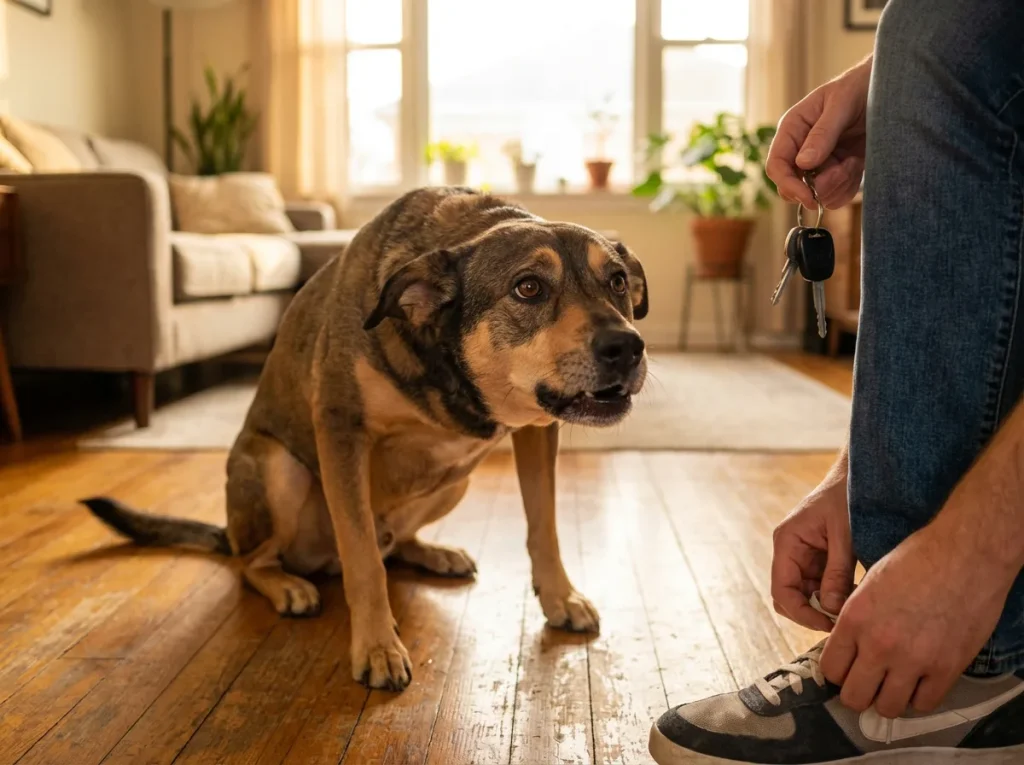
Your dog destroys the house when you leave. You’ve tried everything—more toys, longer walks, crate training—but nothing works. The real question isn’t “why is my dog being bad?” It’s whether you’re dealing with separation anxiety, a treatable panic disorder that affects 20-40% of dogs.
Quick Answer: How Do I Know If My Dog Has Separation Anxiety?
Your dog has separation anxiety if they show distress behaviors only when alone—destructive chewing at doors and windows, continuous howling for over 30 minutes, or house accidents despite being potty trained. The key difference from boredom: these behaviors start immediately when you leave and stem from panic, not lack of stimulation. An anxious dog ignores toys and food; a bored dog eventually settles down.

What You’ll Learn
- Take the 10-Question Separation Anxiety Quiz (2 minutes)
- Anxiety vs Boredom: The 7 Key Differences
- The 8 Signs Your Dog Has Separation Anxiety
- What Causes Separation Anxiety in Dogs?
- How to Help Your Dog Right Now (3 Steps)
- Treatment Options That Actually Work
- FAQs from Dog Owners
The Separation Anxiety Quiz
Does my dog have separation anxiety? Answer YES or NO to each question. This quiz is based on diagnostic criteria used by veterinary behaviorists.
Does My Dog Have Separation Anxiety?
Check every box that applies to your dog:

Separation Anxiety vs Boredom: The 7 Key Differences
"How do I know if my dog has separation anxiety or is just bored?" This is the most common question from dog owners. Here's the definitive comparison:
| Behavior Category | Bored Dog | Anxious Dog | Why This Difference Matters |
|---|---|---|---|
| What Gets Destroyed | Chews whatever is available—couch cushions, shoes, remote controls, random household items spread throughout the house | Targets exit points specifically—doorframes, window sills, door molding, weatherstripping. Destruction is concentrated where you disappeared | The targeted pattern reveals escape attempts (anxiety) vs. entertainment-seeking (boredom). Random destruction = looking for fun. Exit-point destruction = trying to follow you |
| When Destruction Happens | Typically 1-3 hours after you leave, once initial nap time is over and dog seeks stimulation | Within 5-30 minutes of departure. Video shows they never settle and immediately start pacing/attempting to follow you | Timing reveals motivation. Delayed destruction = boredom after rest period. Immediate destruction = panic response to your departure |
| Response to Enrichment | A frozen Kong, puzzle feeder, or bully stick keeps them occupied. They eat the food and engage with toys. Adding more exercise dramatically reduces destruction | Completely ignores even favorite treats and toys. A Kong stuffed with peanut butter sits untouched. Doubling exercise has no impact on anxiety behaviors | If enrichment and exercise solve it, it was boredom. If they ignore solutions, you're dealing with anxiety that overrides normal motivators |
| Settling Behavior | Eventually tires and naps. Security camera footage shows periods of rest between activity bursts | Never settles. Cameras show continuous pacing, circling, vigilance at doors/windows for hours. Dog remains in heightened arousal state entire time alone | Ability to eventually relax proves boredom (they just needed activity first). Inability to ever settle is a hallmark of anxiety disorder |
| Vocalization Pattern | May bark occasionally at noises (mailman, squirrels, passing dogs). Has quiet periods between barking bouts | Continuous, rhythmic howling or barking that doesn't stop. Vocalization is repetitive and sounds distressed—higher pitched and more frantic than normal barking | Intermittent barking = responding to environment (boredom). Non-stop vocalization = distress signaling (anxiety). The pattern tells you everything |
| Greeting Intensity | Happy to see you with normal excited behavior—wagging tail, bringing toys, brief jumping that calms within 1-2 minutes | Frantic, desperate greeting that looks like relief from trauma—spinning, urinating, trembling, refusing to leave your side for 15+ minutes. Intensity doesn't match absence length | Normal greeting = "Yay you're home!" Excessive greeting = "Thank god you survived, I thought you were gone forever!" The relief response reveals their experience |
| House Training Reliability | Maintains house training. Accidents are rare and usually related to schedule changes or truly needing to go | Has accidents despite being let out immediately before departure and being reliably housetrained for months/years. Stress overrides bladder control | A housetrained dog having accidents only when alone is a major red flag. Panic causes involuntary elimination—this is physiological, not behavioral |
The One-Sentence Test
If your dog would be fine with a dog walker coming midday, you have boredom. If they panic the moment any human leaves (even with company), you have separation anxiety.
The 8 Definitive Signs of Separation Anxiety
These are the clinically recognized symptoms veterinary behaviorists use to diagnose separation anxiety in dogs. You need multiple symptoms occurring together, not just one isolated behavior.
1. Pre-Departure Anxiety (Shadow Phase)
What it looks like: Your dog starts showing stress signals 30-60 minutes before you leave—during your getting-ready routine. They pace between you and the door, whine when you're in the shower, pant while you drink coffee, or plant themselves blocking the exit.
Why it matters: This anticipatory anxiety proves your dog has learned your departure routine and dreads it. They're already in fight-or-flight mode before you've left. Dogs experiencing mere boredom don't show distress while you're still home.
What causes it: Classical conditioning. Your dog has associated specific actions (keys jingling, shoes going on, makeup application) with the terrifying experience of being left alone. Their amygdala triggers the stress response before the threat even occurs.
2. Destruction Focused on Exit Points
What it looks like:
- Doorframes with chew marks and gouges
- Scratched or clawed doors with visible marks
- Torn window blinds or curtains
- Damaged weatherstripping
- Carpet or flooring torn up specifically at thresholds
- Chewed door handles or locks
- Broken crate bars or gates (bent metal, broken teeth from chewing)
Why it matters: This is the signature symptom separating anxiety from boredom. The targeted pattern reveals escape behavior. Your dog is trying to get through the door you disappeared through or the window they saw you leave from.
What to document: Take photos of the destruction patterns. Veterinary behaviorists use this evidence to confirm diagnosis. Random household destruction doesn't follow this pattern.
3. Excessive Vocalization
What it looks like: Continuous barking, howling, or crying lasting 30 minutes to several hours. Neighbors report the noise. The vocalization is:
- Repetitive and rhythmic
- High-pitched and urgent sounding
- Non-stop without breaks for rest
- Beginning within minutes of your departure
Why it matters: Your dog is issuing distress signals, the same vocalization puppies use when separated from their mother. This isn't boredom barking at stimuli—it's a panicked attempt to call you back.
Set up a camera: Many owners don't realize their dog vocalizes all day until neighbors complain or they record it. Apps like Furbo or basic security cameras reveal the true extent.
4. House Soiling Despite Training
What it looks like: Urination or defecation inside the house even though:
- Your dog is fully housetrained
- They were let out right before you left
- They can physically hold it for the time period
- It only happens when alone, never when you're home
Location patterns: Often occurs near doors, on your bed, or in areas with concentrated scent (your laundry, your side of the couch).
Why it matters: Extreme stress overrides trained bladder/bowel control. The sympathetic nervous system activation during panic makes "holding it" physiologically impossible. This is involuntary, not revenge or spite.
Important note: Your dog may appear "guilty" when you return—not because they know they did something wrong, but because they've learned your reaction to accidents is negative. This creates a secondary fear response.
5. Escape Attempts and Self-Injury
What it looks like:
- Bloody paws or paw pads from scratching
- Broken or torn nails
- Broken teeth (especially on crate bars)
- Cuts or scrapes on the muzzle
- Drool puddles or dried drool marks on walls/doors
- Bent crate bars or broken gates
Why it matters: Dogs don't injure themselves out of boredom. Self-injury during escape attempts proves your dog is in a panic state where pain doesn't register normally. The drive to escape is overwhelming their self-preservation instinct.
Medical emergency: If your dog has broken teeth, significant lacerations, or severe injuries, seek veterinary care immediately before addressing the behavioral component.
6. Loss of Appetite When Alone
What it looks like: Your dog refuses to eat their regular meals, high-value treats, or even beloved items like:
- Peanut butter-stuffed Kongs
- Bully sticks or other long-lasting chews
- Fresh meat or cheese
- Puzzle feeders
The test: Leave a treat you know your dog loves. If it's untouched when you return (even after hours), stress has completely suppressed their appetite.
Why it matters: Food is a primary motivator for dogs. When anxiety is high enough to override food drive completely, you're dealing with severe distress. A bored dog will eat treats—an anxious dog can't.
7. Hyperattachment When You're Home
What it looks like:
- Following you from room to room constantly
- Wanting to be in physical contact always
- Anxiety when you close doors (bathroom, bedroom)
- Sitting on your feet or pressed against you
- Watching your every move
- Distress when you're visible but inaccessible (different rooms)
Why it matters: This "velcro dog" behavior when you're home often correlates with panic when you're away. While some breeds are naturally attached, excessive clinginess combined with distress when separated (even by a door) indicates unhealthy hyperattachment.
Normal vs. problematic: A dog who likes being near you but can relax in another room is normal. A dog who paces and whines outside the bathroom door has problematic attachment.
8. Disproportionate Greeting Behavior
What it looks like: When you return—even from 10 minutes away—your dog:
- Spins in circles frantically
- Jumps uncontrollably
- Urinates from excitement/stress
- Trembles or shakes
- Vocalizes intensely (high-pitched barks, whines)
- Cannot calm down for 10-15+ minutes
- Shows behavior that looks more like relief than joy
Why it matters: The greeting intensity doesn't match the absence length. This over-the-top reunion reveals your dog experienced genuine fear that you wouldn't return.
Compare: A dog happy to see you wags and greets you but calms within 1-2 minutes. A dog relieved to survive alone shows desperate, prolonged reunion behavior.
What Causes Separation Anxiety in Dogs?
Understanding why your dog developed separation anxiety helps you address it without guilt. This condition has multiple causes and risk factors.
1. Genetic Predisposition and Breed Tendencies
High-risk breeds:
- German Shepherds
- Australian Shepherds
- Border Collies
- Labrador Retrievers
- Cocker Spaniels
- Bichon Frises
- Toy breeds (Chihuahuas, Yorkies, Toy Poodles)
Why: Working and herding breeds were selectively bred for intense human cooperation and bonding. Toy breeds were bred specifically as companion animals. These genetic traits that make them excellent partners also create vulnerability to separation distress.
Important: Any dog of any breed or mix can develop separation anxiety. Breed simply influences probability, not destiny.
2. Early Life Experiences
Risk factors:
- Separated from mother before 8 weeks old
- Raised without proper socialization
- Never learned gradual alone time as a puppy
- Rehomed multiple times
- Shelter background with unknown history
- Puppy mill origins
Why it matters: The critical socialization period (3-14 weeks) shapes lifelong behavioral patterns. Puppies need safe, gradual exposure to being alone to develop confidence that separations are temporary and non-threatening.
3. Traumatic History or Abandonment
Common triggers:
- Owner surrender to shelter
- Loss of a primary caregiver (death, divorce, moving away)
- Being rehomed after bonding with previous family
- History of abandonment or being lost
Why it matters: Dogs have emotional memory. A dog who was surrendered may develop hypervigilance about being left again, even in a loving new home. Past trauma creates lasting changes in brain chemistry and stress responses.
4. Change in Routine or Environment
Common precipitating events:
- Moving to a new home
- New work schedule (especially returning to office after working from home)
- Family member leaving household (college, divorce)
- Loss of another pet
- New baby or significant household change
- Recovery period after surgery (when owner was constantly present)
Why it matters: Separation anxiety often emerges suddenly after a major transition. Your dog's routine included your presence; when that changes abruptly, they struggle to adapt.
The pandemic factor: Veterinary behaviorists reported a 300% increase in separation anxiety cases after COVID-19 lockdowns ended. Dogs who experienced constant human presence for months developed anxiety when owners returned to offices.
5. Single Traumatic Event While Alone
Examples:
- Severe thunderstorm
- Fireworks
- Break-in or attempted break-in
- House fire or smoke alarm activation
- Medical emergency (seizure, injury, illness)
- Contractor work (loud noises while alone)
Why it matters: One terrifying experience while alone can create lasting association between "alone time" and "danger." The dog's brain pairs separation with trauma, triggering panic during future alone periods.
6. Medical Conditions and Pain
Health issues that can cause or worsen anxiety:
- Cognitive dysfunction syndrome (dog dementia) in senior dogs
- Thyroid imbalance (hypothyroidism)
- Chronic pain conditions
- Vision or hearing loss (makes environment feel less safe)
- Neurological disorders
- Gastrointestinal issues causing discomfort
Why it matters: Rule out medical causes first. A vet exam with full bloodwork should precede behavioral diagnosis. Some medical conditions create anxiety; others make existing anxiety worse.
7. Temperament and Individual Differences
Some dogs are simply more prone to anxiety due to individual temperament—just as some humans are more anxiety-prone than others. This isn't anyone's fault; it's neurobiological individuality.
Signs of anxious temperament:
- Generally nervous disposition
- Startles easily
- Slow to warm up to new situations
- History of other fears (storms, noises)
- Sensitive to changes
What To Do Right Now: 3 Immediate Actions
If you've identified separation anxiety, these steps reduce your dog's panic tonight while you develop a comprehensive treatment plan.
Action 1: Neutralize Your Departures and Arrivals
The mistake most owners make: Emotional goodbyes and enthusiastic reunions.
Saying "Mommy loves you! I'll be back soon! Be a good boy!" with petting and long eye contact makes departures a major emotional event. Similarly, greeting your dog with "I missed you SO much!" and enthusiastic celebration makes returns emotionally charged.
What this creates: Maximum contrast between "together time" (amazing) and "alone time" (devastating). You're accidentally training your dog that your presence/absence is worthy of extreme emotional responses.
Do this instead starting today:
15 minutes before leaving:
- No eye contact with your dog
- No talking to your dog
- No touching or petting
- Go about your routine as if your dog isn't there
- If your dog approaches you, calmly step around them
When you return:
- Walk in the door without acknowledging your dog
- Put down your things, ignore jumping/excitement
- Don't make eye contact or speak
- After 15 full minutes of ignoring them, calmly greet with brief petting
- Keep your tone neutral and calm
Why this works: You're reducing the emotional intensity around transitions. Your comings and goings become unremarkable rather than the most exciting or distressing moments of your dog's day.
How long: Maintain this protocol for minimum 2-3 weeks while implementing other training. Once anxiety improves, you can reintroduce brief, calm greetings.
Action 2: Create a High-Value "Departure Cue" Item
The strategy: Give your dog something special they ONLY get when you leave. This begins building a positive association with your departure.
Best options:
Frozen Kong: Stuff with layers of kibble, peanut butter (xylitol-free), pumpkin puree, and treats. Freeze overnight. This can occupy a dog for 30-60 minutes.
Long-lasting chews: Bully stick, yak chew, or beef trachea. Choose size appropriate to ensure 20+ minutes of chewing.
Lick mat: Spread with peanut butter, cream cheese, or wet food. Freeze for longer duration.
Puzzle feeder: Use one specifically for departures, filled with extra special treats.
How to implement:
- Give the item only when you're about to leave
- Give it right at the door as you walk out
- When you return, remove the item immediately (even if uneaten)
- Never give this item at any other time
The critical rule: If your dog is too anxious to engage with the item at all, their anxiety level is too high for this technique to work yet. You need professional help first—don't force it.
Success marker: When your dog starts showing excitement when you pick up your keys (because it means they get their special item), you've created a positive association.
Action 3: Stop All Punishment Immediately and Permanently
What many owners do: Come home to destruction and:
- Yell at the dog
- Show them the mess and scold them
- Use physical corrections
- Put the dog in timeout
- Rub their nose in accidents
Why this is devastating: Your dog was experiencing a panic attack. They weren't "being bad"—they were in genuine distress with their rational brain offline. Punishment teaches them:
- Your return is scary too (you might yell)
- Their anxiety was justified (bad things do happen)
- They should fear you, adding more stress to an already stressful situation
The guilt myth: That "guilty look" when you come home isn't guilt—it's a learned fear response to your body language and tone. Dogs don't have the cognitive ability to feel guilty about past actions. They're responding to your current anger.
Do this instead:
When you come home to destruction:
- Take a deep breath before entering
- Greet your dog calmly (after the 15-minute ignore period)
- Clean up the mess completely out of your dog's sight
- Show zero emotional reaction to the destruction
- Process your frustration away from your dog
Important mindset shift: Your dog didn't destroy your home to punish you. They destroyed your home because they were terrified. They need your help, not punishment.
If you're overwhelmed: It's okay to feel frustrated about destroyed property. That's valid. But express those feelings to a friend, not to your dog who was suffering.
Proven Treatment Options for Separation Anxiety
Separation anxiety is highly treatable, but requires time, consistency, and often professional help. Here's what actually works based on veterinary behavioral science.
Systematic Desensitization Training (The Gold Standard)
What it is: Gradually teaching your dog that departures are brief, safe, and always result in your return. You systematically expose them to tiny increments of alone time, always staying below their panic threshold.
How it works:
Phase 1: Desensitizing to pre-departure cues (Week 1-2)
- Pick up keys and put them down 50 times a day
- Put on shoes and take them off without leaving
- Touch the doorknob without opening door
- Practice these cues randomly when you're not actually leaving
Phase 2: Door exercises (Week 2-3)
- Open door, stand in doorway, close door (you never left)
- Step outside for 2 seconds, come back in
- Step outside for 5 seconds, come back in
- Step outside for 10 seconds, come back in
- ONLY progress when your dog shows zero stress
Phase 3: Brief absences (Week 3-8+)
- Leave for 30 seconds and return
- Leave for 1 minute and return
- Leave for 2 minutes and return
- Gradually build to 5, 10, 15, 30 minutes
- The key: if your dog shows any anxiety, you went too fast
Critical rules:
Never trigger a panic episode: If your dog shows distress, you've pushed too far. Go back to a duration they were comfortable with.
Multiple repetitions: Do 5-10 brief departures daily rather than one long absence. Your dog learns faster with more repetitions.
Irregular timing: Don't leave for exactly 5 minutes every time. Vary duration (3 min, 7 min, 5 min, 2 min) so your dog can't predict length.
No actual departures during training: This is the hardest part. While desensitization training is happening, you cannot leave your dog for real errands and trigger full panic. Use doggy daycare, pet sitters, or bring your dog with you.
Timeline: Expect 8-16 weeks minimum for moderate cases. Severe cases may take 6-12 months. This requires patience.
Counterconditioning (Pairing Departures with Rewards)
What it is: Creating positive associations with being alone by pairing it with things your dog loves.
How to implement:
Special toy protocol:
- Have one toy that's the most exciting thing ever
- Only bring it out when you leave
- When you return, the toy disappears
- This makes your departure a predictor of good things
Scatter feeding:
- Right before you leave, scatter high-value treats around the house
- Your dog spends the first 10-15 minutes foraging
- This occupies them during the highest-stress period (your departure)
Alone time = treat time:
- Every time you practice a departure, toss amazing treats
- When you return, treats stop
- Your dog learns: "alone" means "treat party"
Important: This only works for mild-moderate anxiety. Severely anxious dogs can't eat during panic, making food-based counterconditioning impossible until anxiety is reduced through other means.
Medication (When Necessary)
When medication is needed:
- Anxiety is severe enough to prevent eating/drinking
- Dog is injuring themselves
- Training progress has stalled despite consistent work
- Chronic stress is affecting physical health
Environmental Management and Support
Strategies that help:
Dog walker/doggy daycare:
- Reduces time alone during the training period
- Provides socialization and exercise
- Breaks up the day for dogs who can't yet handle 8-hour stretches
Exercise before departures:
- A tired dog has lower baseline anxiety
- 30-60 minutes of exercise before you leave
- Mental stimulation (training, sniff walks) tires them more than physical exercise alone
Calming aids (mild to moderate anxiety):
- Adaptil (dog appeasing pheromone) diffuser
- Thundershirt or anxiety wrap (gentle pressure)
- Calming music (specifically designed for dogs)
- White noise to mask trigger sounds
Camera setup:
- Furbo, Petcube, or basic security camera
- Watch your dog in real-time to gauge stress levels
- Track progress objectively
- Speak to them (some cameras have treat-tossing features)
Safe space creation:
- Give your dog access to areas with your scent
- Leave recently worn clothing
- Background noise (TV, radio on talk station)
- Multiple comfort zones rather than isolation
What Does NOT Work
Avoid these common mistakes:
Getting a second dog: Your dog's anxiety is about you leaving, not about being alone generally. A second dog won't fix it and may result in two anxious dogs.
Punishment: Makes anxiety worse by adding fear of your return to fear of being alone.
Ignoring it hoping it improves: Separation anxiety escalates over time without intervention.
Crate training a severely anxious dog: Can result in broken teeth, torn nails, and extreme panic. Only use crates after separate, gradual crate desensitization with a professional.
CBD products: Research is mixed and quality varies wildly. Some dogs respond; many don't. Not a standalone solution.
Extended daycare as sole solution: Helps during training but doesn't teach your dog to be comfortable alone. Must be paired with desensitization.
Finding Professional Help
Who to contact based on severity:
For Mild Cases:
Certified Professional Dog Trainer (CPDT-KA) with separation anxiety experience. Look for trainers who:
- Use force-free, positive reinforcement methods
- Have specific separation anxiety case experience
- Offer virtual coaching (very common for this issue)
For Moderate to Severe Cases:
Certified Separation Anxiety Trainer (CSAT) - specialists who work exclusively on separation anxiety using evidence-based protocols. Find them at: MalisaBehaviour.com or SeparationAnxietyDog.com
For Severe Cases or Medication:
Veterinary Behaviorist (DACVB) - board-certified specialists in behavioral medicine. They can:
- Diagnose complex cases
- Prescribe medication
- Create comprehensive treatment plans
- Rule out medical causes
Find them at: DACVB.org
Red flags (avoid trainers who):
- Claim separation anxiety can be fixed in days
- Recommend punishment or "tough love"
- Use shock collars or aversive tools
- Don't understand desensitization protocols
- Promise cures without medication when needed
Cost considerations:
- CSAT programs: $1,000-3,000 for full protocol
- Veterinary behaviorist consultation: $400-800 initial
- Medication: $20-80 monthly
- Compare to cost of destroyed property, security deposits lost, or rehoming
Virtual training works: Most separation anxiety training is done remotely since the trainer needs you to leave anyway. This also makes top specialists accessible regardless of location.
Frequently Asked Questions
Will getting a second dog help with separation anxiety?
No. Getting another dog rarely solves separation anxiety and often makes things worse.
Your dog's anxiety is specifically about you leaving, not about being alone in general. The attachment is to you as their human, not to having canine companionship. Research shows that dogs with separation anxiety often completely ignore other dogs in the household when their human leaves—they're not seeking company, they're seeking you.
What actually happens when you get a second dog:
Best case scenario: Your anxious dog continues being anxious, and your new dog is confused about why the other dog is panicking. You now have one anxious dog and one unaffected dog.
Common scenario: Your anxious dog's distress behaviors (pacing, whining, panting) stress out the new dog, who begins mirroring the anxiety. Within weeks to months, you have two dogs with separation anxiety.
Worst case scenario: Your severely anxious dog becomes aggressive toward the new dog due to stress, or the new dog also came from a shelter with unknown history and develops its own behavioral issues.
The only time a second dog works: If your dog's anxiety is fully resolved first, and you want another dog for your own reasons (not as a "fix"), and you carefully select a calm, confident dog, it might be fine. But never get a second dog as separation anxiety treatment.
What does work: Professional desensitization training addressing your dog's attachment to you specifically.
Can I crate train a dog with separation anxiety?
Yes, but only with extreme caution and never as a quick fix.
A crate can become a safe den for an anxious dog, but the process must be completely separated from separation anxiety treatment. Forcing a panicked dog into a crate is dangerous and can result in:
- Broken teeth from chewing crate bars
- Torn nails and bloody paws from scratching
- Severe panic attacks making anxiety worse
- Physical injuries requiring veterinary care
- Permanent negative association with crates
The right approach if you want to try crating:
Phase 1: Make the crate amazing (2-4 weeks)
- Feed every meal in the crate with door open
- Toss treats randomly into the crate throughout the day
- Never close the door initially
- Let your dog choose to enter and exit freely
- Place comfy bedding and make it inviting
- Put the crate in a social area, not isolation
Phase 2: Door conditioning (2-3 weeks)
- Close door for 2 seconds while you're sitting right there, open immediately
- Gradually increase to 10 seconds, 30 seconds, 1 minute
- Always open before your dog shows stress
- Feed meals with door closed (only if dog is relaxed)
- Never leave the room during this phase
Phase 3: Brief absences from room (2-3 weeks)
- Close crate, step out of sight for 5 seconds, return
- Gradually build up time out of sight
- Return before any stress signals appear
- This phase takes weeks, not days
Critical rules:
- Never use the crate for punishment
- Never force your dog inside
- If your dog panics at any point, you
Comments are closed.