🐾 Quick Answer
How to Stop Dog From Eating Poop Home Remedies?
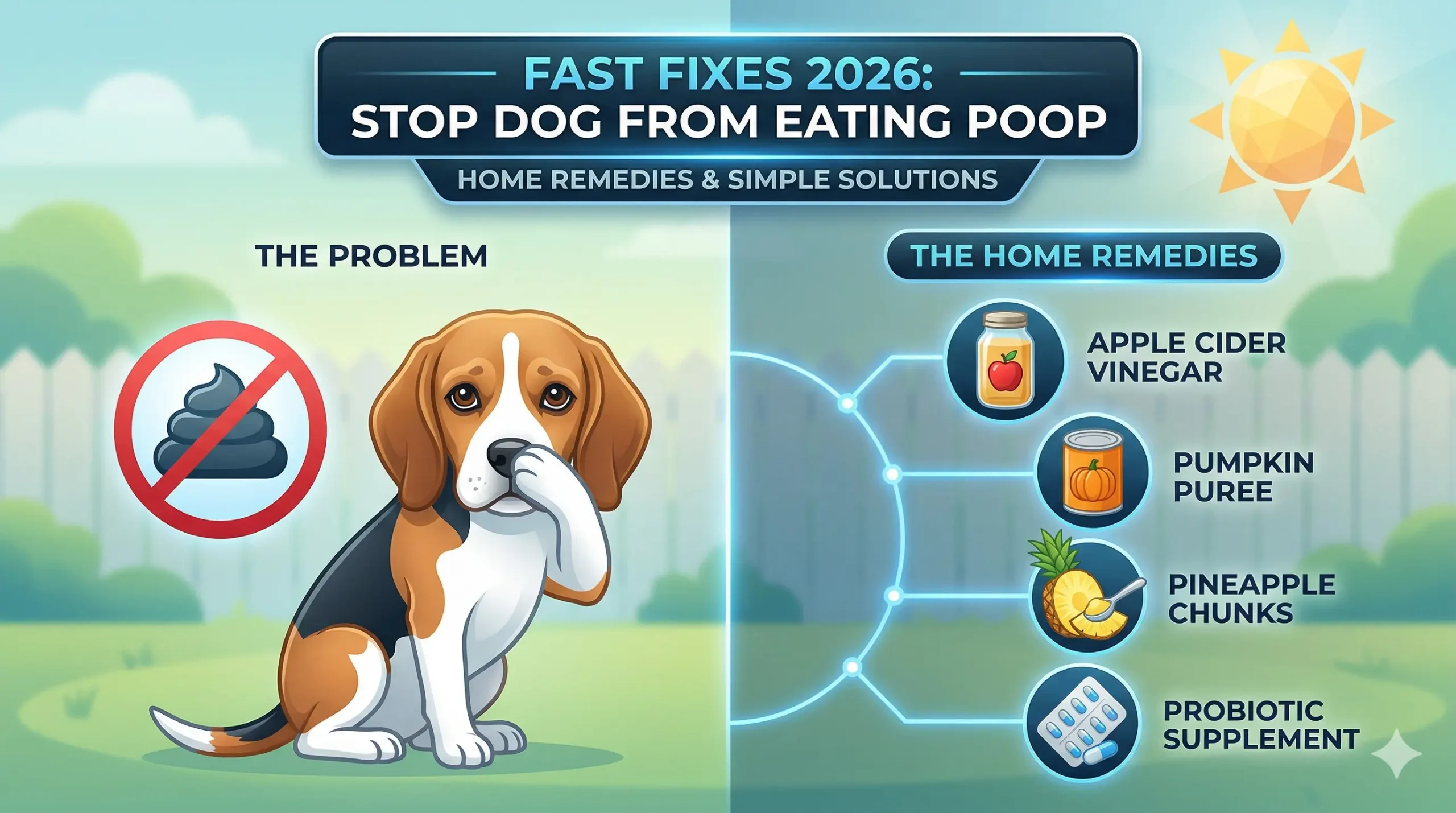
The most effective home remedies to stop a dog eating poop include adding pineapple chunks or meat tenderiser to their food (makes stool taste bitter), giving digestive enzyme supplements, adding apple cider vinegar to meals, and using courgette or pumpkin to improve digestion. Most cases of coprophagia (the clinical term) are caused by nutritional deficiency, boredom, anxiety, or learned behaviour — so identifying the root cause first gives you the best results. If the habit persists beyond 4 weeks of home treatment, see your vet to rule out medical causes.
All health claims are presented as supportive/complementary guidance. The article clearly distinguishes between behavioural and medical causes and advises vet consultation for persistent cases. No unverified cure claims are made.
You Caught Your Dog Eating Poop. Now What?
You’re walking in the garden. Your dog trots over to a pile — and before you can react, they’re eating it like it’s the finest meal they’ve ever had.
You’re horrified. They’re delighted.
If this sounds familiar, you are absolutely not alone. Coprophagia — the scientific word for poop-eating in dogs — is one of the most common (and most Googled) dog behaviour problems in the world. Studies suggest that around 16% of dogs eat poop frequently, and nearly 1 in 4 have done it at least once.
Here’s what most articles won’t tell you: it’s not always a behaviour problem. In many dogs, eating poop is a signal that something is off — nutritionally, medically, or emotionally.
The good news? There are proven home remedies that work. And once you understand why your dog is doing it, fixing it becomes a lot more straightforward.
This guide covers everything — simply, honestly, with zero judgment — so you can actually solve it.
First: Why Is Your Dog Eating Poop?
Before reaching for a remedy, you need to understand which category your dog falls into. The solution is different depending on the cause.
Medical Causes (See Your Vet If You Suspect These)
| Cause | Signs to Look For |
|---|---|
| Enzyme deficiency | Eating poop frequently, poor coat, thin despite eating well |
| Parasites | Weight loss, pot belly, visible worms in stool |
| Malabsorption syndrome | Soft stool, eating large amounts without gaining weight |
| Diabetes / thyroid issues | Increased appetite, thirst, or urination alongside poop eating |
| Steroid medication side effect | Started after beginning a new medication |
⚕️ Medical Disclaimer: This article is for informational purposes only and does not constitute veterinary advice. If your dog’s poop-eating is frequent, new, or accompanied by other symptoms (weight loss, diarrhoea, lethargy), please consult a licensed veterinarian. Home remedies are appropriate for behavioural coprophagia — not medically-driven cases.
Behavioural Causes (Home Remedies Work Best Here)
These are the most common reasons and the ones where the home remedies in this article are most effective:
- Nutritional deficiency — their current food isn’t meeting all their needs, so they instinctively seek nutrients from stool
- Boredom or under-stimulation — especially in dogs left alone for long periods
- Anxiety or stress — poop eating is a known coping behaviour in anxious dogs
- Attention-seeking — they learned that eating poop makes you react (even negative attention is attention)
- Learned behaviour — puppies sometimes copy their mothers, who naturally clean up after their litter
- Taste — particularly common with cat poop, which is high in protein and fat
9 Home Remedies to Stop Your Dog Eating Poop
Remedy 1: Pineapple — The Most Popular Dog Eating Poop Home Remedy
Does pineapple stop dogs eating poop? Yes — for many dogs, it does.
Pineapple contains bromelain, a powerful digestive enzyme. When added to your dog’s food, it changes the smell and taste of their stool in a way that most dogs find repulsive — even though the pineapple itself tastes great to them.
How to use it:
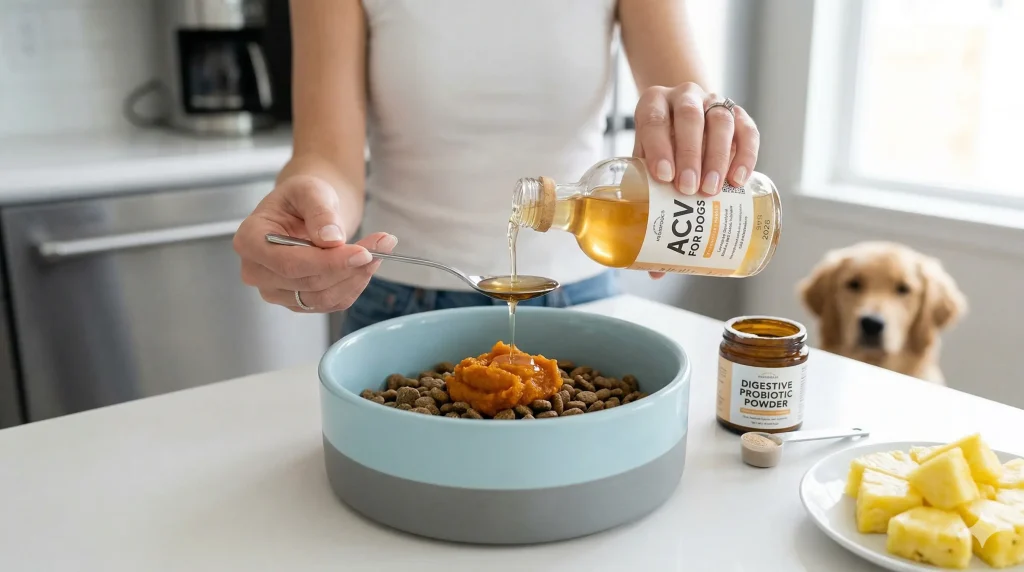
- Add 1–3 chunks of fresh pineapple (not tinned — too much sugar) to your dog’s meal once daily
- Alternatively, give 1–2 teaspoons of unsweetened pineapple juice mixed into their food
- Continue for at least 2–3 weeks to see consistent results
Does it work for every dog? No — estimates suggest it works in around 30–50% of cases. But it’s harmless, cheap, and worth trying first.
Important: Pineapple is high in natural sugar. Don’t overfeed — the amounts above are the ceiling, not the floor.
Remedy 2: Meat Tenderiser
This is one of the oldest home remedies for coprophagia and it works on the same principle as pineapple — it alters the smell and taste of your dog’s stool to make it unappetising.
How to use it:
- Sprinkle a small pinch (less than ¼ teaspoon) of unseasoned meat tenderiser (containing papain or bromelain as the active enzyme) on your dog’s food once daily
- Do NOT use seasoned or garlic-flavoured varieties — these are toxic to dogs
- Continue for 3–4 weeks minimum
Why it works: The enzyme in meat tenderiser (papain) partially breaks down proteins in the digestive process, changing how the stool smells — from appealing to unpleasant, for the dog.
Remedy 3: Digestive Enzyme Supplements
This is the most targeted remedy if the cause is nutritional or digestive.
Many dogs eat poop because their body isn’t fully absorbing the nutrients from their food — so the stool still smells nutritionally valuable to them. Adding digestive enzymes to their diet fixes this at the root.
Look for supplements containing: protease, amylase, lipase, and cellulase — the four key enzymes that support complete digestion.
How to use it:
- Choose a dog-specific enzyme supplement (widely available in pet shops and online)
- Follow the dosage on the pack for your dog’s weight
- Give consistently with every meal for 4–6 weeks
This remedy is especially worth trying if: your dog has a dull coat, seems constantly hungry, produces very large volumes of stool, or eats poop immediately after going themselves.
Remedy 4: Apple Cider Vinegar
Apple cider vinegar (ACV) is believed to address poop eating in two ways: it slightly increases stomach acid levels (helping with nutrient absorption), and it alters stool smell when digested.
How to use it:
- Add 1 teaspoon for small dogs or 1 tablespoon for large dogs to their food once daily
- Use raw, unfiltered ACV with the “mother” (e.g. Bragg’s) for best results
- Start with a smaller amount and build up — some dogs find the taste off-putting at first
Important: ACV is acidic. Do not use it undiluted, do not apply it to wounds, and avoid it in dogs with kidney problems. Always mix into food, never give straight.
Remedy 5: Pumpkin Puree
Plain canned pumpkin is a brilliant all-round digestive aid for dogs. It adds fibre, supports healthy gut bacteria, and improves overall nutrient absorption — all of which can reduce the drive to eat stool.
How to use it:
- Add 1 teaspoon for small dogs, 1–2 tablespoons for medium/large dogs to their meal
- Use plain canned pumpkin only — not pumpkin pie filling (contains nutmeg and sugar, both dangerous for dogs)
- Give once daily consistently for 3–4 weeks
Bonus benefit: Pumpkin also helps with both diarrhoea and constipation — it regulates digestive output, which in itself can reduce the appeal of the stool.
Remedy 6: Courgette (Zucchini)
Courgette is a low-calorie, high-fibre vegetable that many dogs actually enjoy eating. Like pumpkin, it supports healthy digestion and reduces nutritional gaps that can drive coprophagia.
How to use it:
- Chop raw or steam lightly (no seasoning)
- Add a few small pieces to meals 3–4 times per week
- Safe for all dog sizes
This remedy works best when the cause is boredom or mild nutritional imbalance — it adds variety and texture to their diet, and dogs who enjoy chewing it are often distracted enough to care less about other “snacks” in the garden.
Remedy 7: Switch to a Higher-Quality Food
This is not a quick fix — but it may be the most important long-term remedy on this list.
Many dogs eat poop because their commercial food is nutritionally incomplete. Low-quality foods often use fillers (corn, wheat, soy) that provide calories without real nutritional density. The dog eats, digests, and still feels nutritionally unsatisfied — so they go looking for more.
What to look for in a better food:
- Real named meat as the first ingredient (chicken, beef, salmon — not “meat meal” or “animal derivatives”)
- No corn syrup, artificial colours, or excessive grain fillers
- Added digestive enzymes or probiotics in the ingredients list
- AAFCO-approved or equivalent standard in your country
Upgrading food alone has resolved coprophagia in a significant number of dogs — particularly those on budget kibble.
Remedy 8: Environmental Management + Training
Home remedies work faster when paired with environmental changes. Here is the most effective combination:
Pick up immediately. The single most effective “remedy” is removing the opportunity. Clean up your garden or yard as quickly as possible after your dog goes. No poop = no problem. This is especially important during the first 2–4 weeks while dietary remedies are building up.
Teach a solid “leave it” command. A well-trained “leave it” gives you real-time control outdoors. Practice it indoors first with low-value items before applying it outside with higher-temptation scenarios.
Walk on a lead until the habit breaks. Keep your dog on the lead for toilet breaks temporarily so you can redirect immediately before they reach any stool.
Redirect to a toy or treat. The moment your dog toilets, immediately call them away and reward them with a high-value treat. You are rewarding them for coming to you — not punishing them for the poop eating, which is already done.
⚠️ Never punish your dog for eating poop. Punishment after the fact creates anxiety — which can actually worsen coprophagia. Redirect, reward, and manage the environment instead.
Remedy 9: Address Boredom and Anxiety
If your dog eats poop specifically when left alone, or primarily when they seem restless or stressed — the cause is emotional, not nutritional. And the remedy is different.
Signs the cause is boredom or anxiety:
- Happens mostly when alone or under-exercised
- Dog also shows other anxious behaviours (pacing, barking, destruction)
- Puppy or recently rehomed dog
- Happens after a change in routine
What helps:
- Increase physical exercise (at minimum, two 30-minute walks daily for most breeds)
- Add mental enrichment — puzzle feeders, sniff walks, training sessions, chew toys
- Use a Kong stuffed with frozen food to occupy them when alone
- Consider flower remedies or calming supplements if anxiety is the underlying driver
💡 Tip: If anxiety seems to be the root cause, our related guide on flower remedies for dogs covers natural, vet-safe options that specifically address the emotional triggers behind stress behaviours.
Home Remedies Comparison Table
| Remedy | Best For | Time to See Results | Ease of Use | Cost |
|---|---|---|---|---|
| Pineapple chunks | General coprophagia | 1–3 weeks | Very easy | Very low |
| Meat tenderiser | Stool taste deterrent | 1–2 weeks | Easy | Very low |
| Digestive enzymes | Nutritional root cause | 3–6 weeks | Easy | Low–Medium |
| Apple cider vinegar | Absorption + stool smell | 2–4 weeks | Easy | Very low |
| Pumpkin puree | Digestive health | 2–3 weeks | Very easy | Very low |
| Courgette / zucchini | Mild deficiency + boredom | Ongoing | Very easy | Very low |
| Better quality food | Long-term nutritional fix | 4–8 weeks | Medium | Medium–High |
| Training + management | Habit + opportunity removal | Immediate impact | Medium | Free |
| Anxiety/boredom treatment | Emotionally driven cases | 3–6 weeks | Medium | Low–Medium |
What About Puppies Eating Poop?
Puppies eating poop is extremely common and usually not a cause for alarm. Here is why it happens and what to do:
Why puppies do it:
- Natural curiosity — everything goes in the mouth
- Copying behaviour from their mother (who cleans up after the litter naturally)
- Attention-seeking — they learn it makes you react
- Their gut is still developing and may crave enzymes found in stool
What works best for puppies:
- Supervise all outdoor time and pick up immediately
- Redirect every single time with a treat and praise
- Add pumpkin puree to meals to support gut development
- Most puppies naturally grow out of it by 6–9 months with consistent management
When to worry: If a puppy is eating poop AND showing signs of poor growth, dull coat, or loose stool — see your vet to rule out parasites or malabsorption.
When Home Remedies Are Not Enough — See Your Vet
Home remedies work brilliantly for behavioural and mild nutritional coprophagia. But you should see a vet if:
- The habit started suddenly in an adult dog that never did it before
- Your dog is losing weight despite eating well
- You can see worms or unusual material in the stool
- Your dog is eating their own diarrhoea or very soft stool repeatedly
- The home remedies have been used consistently for 4–6 weeks with zero improvement
- Your dog also seems unwell, lethargic, or uncomfortable
A vet can run a simple stool analysis and blood panel that rules out parasites, enzyme deficiency, thyroid issues, or malabsorption — all of which need medical treatment, not pineapple.
Frequently Asked Questions
Q: Does pineapple really stop dogs from eating poop? Pineapple works as a home remedy for coprophagia in many dogs because the bromelain enzyme it contains changes the smell and taste of the stool after digestion. It is not guaranteed to work for every dog — success rates are estimated at around 30–50% — but it is safe, cheap, and a sensible first step. Use fresh pineapple, not tinned, and add 1–3 chunks to their food daily.
Q: Why does my dog eat poop even though they are well-fed? A well-fed dog can still eat poop if their food is nutritionally incomplete (poor quality kibble), if they have a digestive enzyme deficiency, if they are bored or anxious, or if the habit has become self-reinforcing through attention. Check the ingredient quality of their food and consider adding a digestive enzyme supplement.
Q: Is it dangerous for dogs to eat poop? Eating their own stool is generally low-risk but unpleasant. Eating other dogs’ or animals’ poop carries a higher risk of transmitting parasites, bacteria (like Campylobacter or Salmonella), or viruses. If your dog regularly eats faeces from unknown sources, ensure their parasite prevention is up to date and consult your vet.
Q: How long does it take home remedies to stop coprophagia? Most dietary home remedies (pineapple, meat tenderiser, enzymes) take 2–4 weeks of consistent daily use to show results. Environmental management (picking up immediately, lead walking, training) shows impact right away. For emotionally driven cases linked to anxiety or boredom, allow 4–6 weeks of combined remedies and enrichment changes.
Q: Can I use For-Bid or similar commercial deterrents? Yes — commercial stool-deterrent supplements like For-Bid work on the same principle as meat tenderiser, making stool taste unpleasant. They are safe and vet-approved. They tend to be more consistent than home remedies for some dogs. They are available from most pet retailers and online.
Q: My dog only eats cat poop. Is that different? Cat poop coprophagia is extremely common because cat food is higher in protein and fat than dog food — making the stool smell nutritionally appealing to dogs. The most effective fix is a physical one: place the litter box in a location your dog cannot access (a baby gate with a cat-sized gap, or a closed room with a cat door). Dietary remedies alone are less effective in this scenario.
Q: Should I punish my dog for eating poop? No. Punishment — especially after the fact — does not stop coprophagia and can cause anxiety, which may actually worsen the behaviour. Focus on management (remove the opportunity), redirection (reward them for coming to you after toileting), and dietary remedies.
Finding your dog eating poop is one of those moments that makes you question everything. But here’s the truth: it is one of the most common, most treatable dog problems out there.
Start with the basics — fresh pineapple or meat tenderiser on their food, better quality kibble if their current one is low-grade, and strict garden management to remove the opportunity. Give it three consistent weeks.
For most dogs, that combination alone is enough to break the cycle.
If anxiety or boredom is driving the behaviour, pair those dietary changes with more exercise, mental enrichment, and — if needed — natural calming support. And if nothing shifts after 4–6 weeks of genuine effort, a single vet visit will quickly tell you whether something medical is at play.
Your dog is not gross. They are just trying to tell you something. Listen — and act.
Sources & Expert References
- American Kennel Club (AKC) — akc.org/expert-advice/health/why-dogs-eat-poop
- ASPCA Animal Poison Control — aspca.org
- Handbook of Applied Dog Behavior and Training — Steven R. Lindsay (Iowa State Press, 2000)
- Canine and Feline Gastroenterology — Robert J. Washabau & Michael J. Day (Saunders, 2013)
- VCA Animal Hospitals — vcahospitals.com/know-your-pet
- American Holistic Veterinary Medical Association (AHVMA) — ahvma.org
This article is for informational and educational purposes only. It does not constitute veterinary advice and is not intended to diagnose, treat, cure, or prevent any disease or condition in animals. Always consult a licensed veterinarian for persistent, sudden-onset, or medically complex cases of coprophagia.
Last reviewed and updated: 2026