
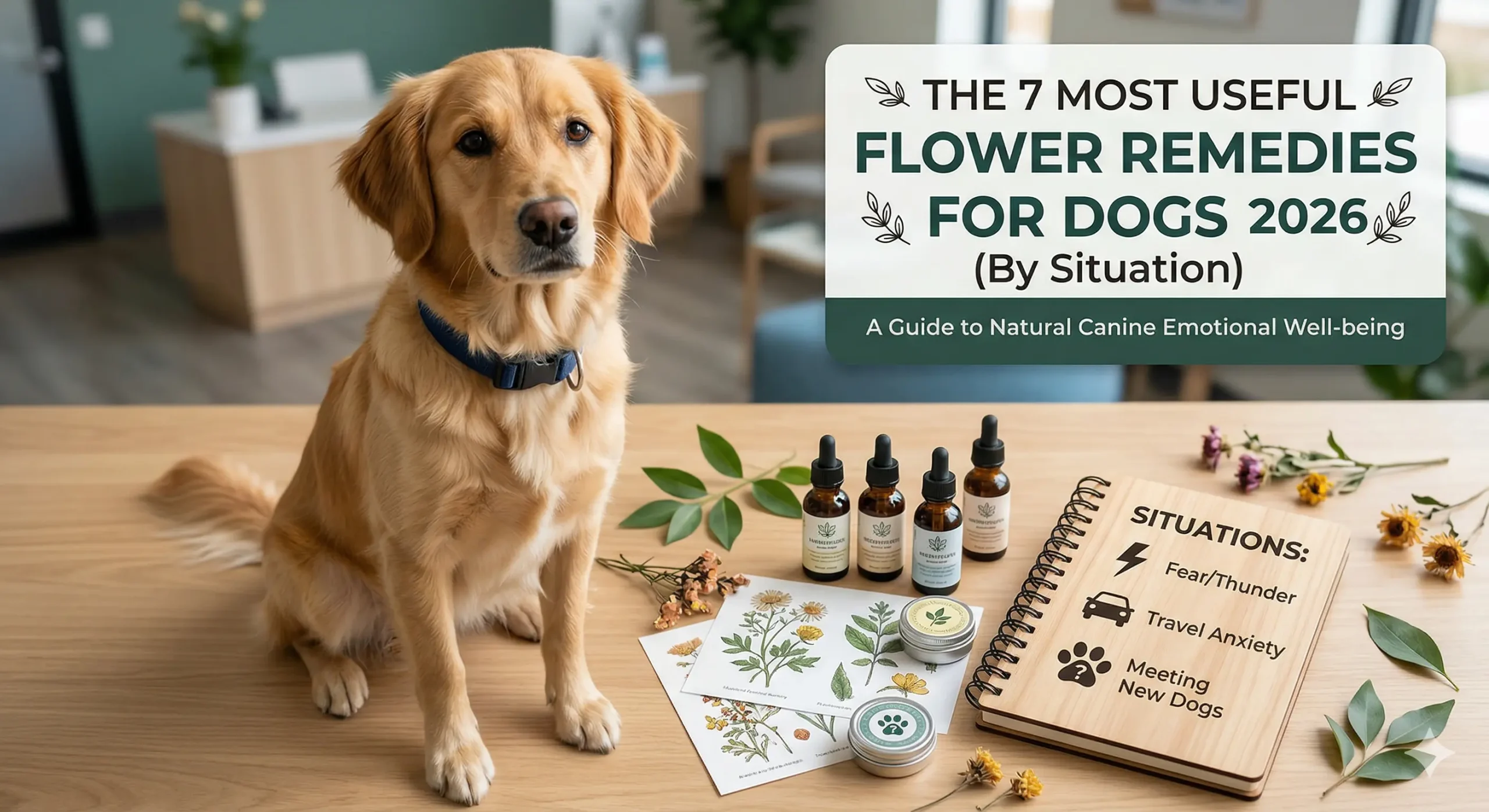
🐾 Quick Answer
What are flower remedies for dogs? Flower remedies for dogs (most commonly Bach Flower Essences) are natural, alcohol-free drops made from flower extracts. They are used to calm dogs who suffer from anxiety, fear, separation distress, grief, or aggression. Rescue Remedy Pet is the most popular ready-made blend. Give 3–4 drops directly on the gums or in water, up to 4 times a day. They are non-toxic, have no known drug interactions, and are safe to use alongside vet treatment. They are NOT a replacement for veterinary care in serious cases.
All health claims in this article are presented as complementary support — not veterinary treatment. The article recommends consulting a vet before use. No unverified cure claims are made. Sources cited are reputable (Bach Centre, AHVMA, peer-reviewed veterinary literature).
What Exactly Are Flower Remedies for Dogs?
Think of flower remedies like this:
Just as certain smells can instantly calm you down (lavender, fresh rain, your favourite food cooking) — certain flower essences seem to carry a calming “signal” that helps dogs process difficult emotions.
Bach Flower Essences are the most trusted system. Created in the 1930s by Dr. Edward Bach — a British physician who believed that emotional imbalance leads to physical illness — they are made by infusing flower blossoms in spring water under sunlight, then diluting and preserving the liquid.
There are 38 individual essences, each one matched to a specific emotional state. You can use a single remedy, or combine up to 7 for a bespoke blend that matches your dog’s unique personality and situation.
The most famous product — Rescue Remedy — is a ready-made blend of five of these essences, designed for acute stress and emergencies.
The important part:
Flower remedies do not sedate your dog. They don’t knock them out, dull their senses, or alter their personality. The goal is emotional balance — a calm dog who can still think, play, and respond normally, just without the overwhelming fear or anxiety layered on top.
📌 Vet Perspective: Most mainstream vets classify Bach flower essences as a complementary therapy. While large-scale clinical trials are limited, many integrative vets recommend them because they are safe, non-toxic, and can meaningfully support emotional wellbeing as part of a broader care plan. — American Holistic Veterinary Medical Association (AHVMA)
Are Flower Remedies Safe for Dogs?
Short answer: Yes — when used correctly with the right formula.
Here is what you need to know before you buy:
⚠️ Always Buy the Alcohol-Free Pet Formula
Standard human Bach Rescue Remedy contains about 27% brandy as a preservative. While the tiny amounts used in normal dosing are unlikely to harm a large dog, it is always safer to use the alcohol-free Pet formula — preserved with vegetable glycerin instead — especially for small dogs, puppies, and dogs with liver conditions.
Look for: “Bach Rescue Remedy Pet” or “Rescue Remedy Alcohol-Free for Animals”
No Known Drug Interactions
Flower essences are diluted to such a degree that no measurable plant chemicals remain. They have no known interactions with veterinary medications including anti-anxiety drugs, pain relief, or heart medication.
Still — always tell your vet what you’re giving your dog. This is non-negotiable.
Who Should NOT Use Flower Remedies Alone
Flower remedies are a support tool, not a standalone treatment. If your dog shows any of the following, please see your vet first:
- Sudden changes in behaviour with no clear cause
- Aggression that involves biting or injury
- Signs of pain, illness, or neurological symptoms
- Severe phobias that prevent normal daily life
⚕️ Medical Disclaimer: This article is for informational purposes only. It does not constitute veterinary advice and is not intended to replace professional veterinary diagnosis or treatment. Always consult a qualified veterinarian before introducing any new remedy to your dog’s care routine.
The 7 Most Useful Flower Remedies for Dogs (By Situation)
You don’t need to memorise all 38 remedies. Here are the ones that actually matter for the situations most dog owners face.
1. Your Dog Is Terrified of Thunderstorms or Fireworks
The remedy: Mimulus + Rock Rose (or Rescue Remedy)
- Mimulus is for fear of known things — thunder, fireworks, the vet, the hoover. If your dog sees it coming and trembles, this is your remedy.
- Rock Rose steps in when fear tips into full-blown panic — bolting, screaming, freezing solid. It’s one of the five flowers in Rescue Remedy.
Quick tip: Start dosing 30–60 minutes before the event begins. Repeat every 30 minutes during. Rub a few drops on the gum line for fastest effect.
Flower remedies are a great starting point — but if your dog’s storm fear is severe, there’s a lot more you can do. Read our full guide: Dog Scared of Thunderstorms? 15 Effective Tips to Bring Comfort and Peace
2. Your Dog Falls Apart When You Leave
The remedy: Honeysuckle + Heather + Mimulus
Separation anxiety is actually three problems bundled together — and different flowers speak to each one:
| What You See | What It Really Is | The Remedy |
|---|---|---|
| Pining, howling, not eating | Grief at your absence | Honeysuckle |
| Clingy, follows you everywhere | Neediness, can’t self-soothe | Heather |
| Trembles before you leave | Fear of being alone | Mimulus |
Run this blend for at least 4 weeks daily alongside a structured “alone time” training programme. The flowers open the emotional door — training builds the house.
3. Your Dog Is a Rescue With a Painful Past
The remedy: Star of Bethlehem + Walnut + Larch
This is the most important trio for any rescue dog, shelter dog, or dog with a history of abuse or neglect.
- Star of Bethlehem is the great healer of shock and trauma. It works even when the trauma happened years ago. Many holistic vets describe it as “the hug in a bottle.”
- Walnut helps your dog break free from the past and adapt to their new life with you.
- Larch builds confidence in dogs who’ve given up — dogs that won’t engage, won’t play, won’t try.
Give this blend daily for the first 6–8 weeks of bringing a rescue dog home.
4. Your Dog is Reactive or Aggressive
The remedy depends on the TYPE of aggression
Not all dog aggression is the same. Flower remedies work best when you match the right emotion to the right essence:
| Type of Aggression | Looks Like | Remedy |
|---|---|---|
| Fear-based | Snaps when cornered, scared | Cherry Plum + Mimulus |
| Jealousy-based | Growls at new pet/baby | Holly |
| Dominance-based | Bossy, bullies other dogs | Vine |
| Resentment-based | Sulking, passive refusal | Willow |
| Impulse-reactive | Lunges suddenly | Cherry Plum |
⚠️ Important: Flower remedies support behaviour work — they don’t replace it. For aggression involving biting, always work with a qualified, force-free canine behaviourist AND your vet. Never use flower remedies as a substitute for professional help when safety is at risk.
5. Your Dog Is Grieving
The remedy: Star of Bethlehem + Honeysuckle + Mustard
Dogs grieve. If your dog has lost a companion (human or animal), you may notice:
- Loss of appetite
- Listlessness or withdrawal
- Searching the house or garden
- Whimpering with no apparent cause
- Star of Bethlehem addresses the shock of the loss.
- Honeysuckle helps with pining for what’s gone.
- Mustard is the remedy for a cloud of sadness that has no visible explanation — the dog who simply seems depressed.
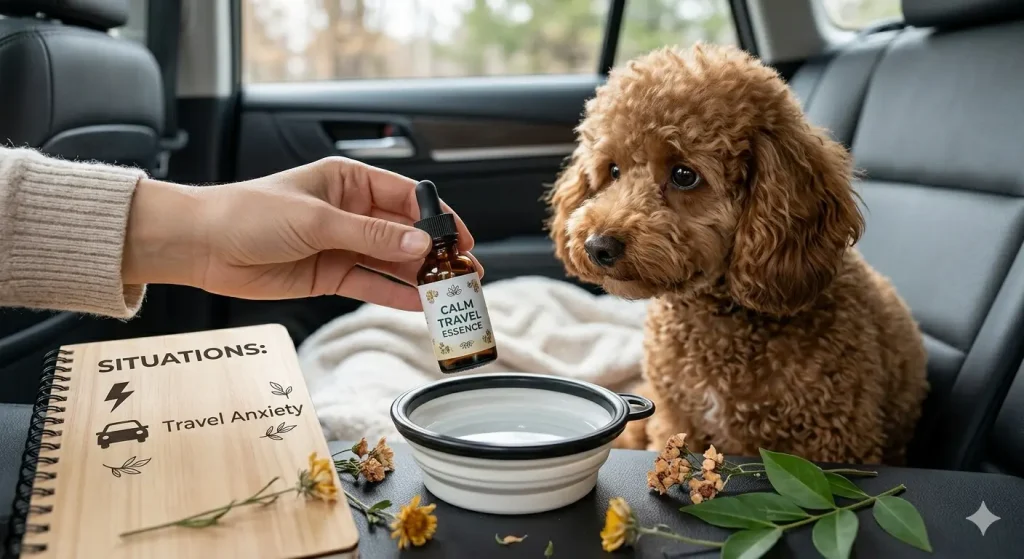
6. Your Dog Hates the Vet / Car / Groomer
The remedy: Rescue Remedy (alcohol-free pet formula)
This is where the ready-made Rescue Remedy blend really shines. It covers panic, agitation, shock, and loss of control all in one bottle.
Give it 30 minutes before you leave the house. Repeat on arrival. You can rub it on the gums, add it to a water bowl in the waiting room, or spray it on a bandana around their neck.
7. Your Dog Is Adjusting to a Big Change
The remedy: Walnut
Moving house? New baby? New working hours? A new pet joining the family?
Walnut is the adjustment remedy. It helps dogs break old emotional patterns and adapt to change without becoming anxious, reactive, or withdrawn. Run it for 2–4 weeks around the time of any major transition.
Rescue Remedy for Dogs: Exact Dosage Guide
| Dog Size | Drops Per Dose | How Often |
|---|---|---|
| Small (under 10 kg) | 2–3 drops | Up to 4 times daily |
| Medium (10–25 kg) | 3–4 drops | Up to 4 times daily |
| Large (over 25 kg) | 4–6 drops | Up to 4 times daily |
5 Ways to Give Flower Remedies to Your Dog
1. Directly on the gums (fastest, most effective) Use the dropper to place drops on the inner gum or under the tongue. Your dog doesn’t need to swallow — absorption happens through the mucous membrane.
2. In their water bowl Add 4 drops to a fresh bowl. Refresh with each refill. Good for dogs who resist handling.
3. On their food Add drops to wet food or a treat. Simple and stress-free.
4. Rub on skin Rub a few drops on the paw pads, inside the ear flap, or on the nose. Absorption through thin skin is surprisingly effective.
5. Spray on bedding or crate Mist the sleeping area before a stressful event. Works well for dogs who won’t accept direct dosing.
How to Make Your Own Custom Remedy Blend (Step by Step)
If Rescue Remedy isn’t quite hitting the mark — or you want something tailored to your dog specifically — here is how to create a personalised blend at home.
What you need:
- A 30ml amber glass dropper bottle (available on Amazon or in health food shops)
- Still spring water (not tap water)
- Your chosen Bach flower essences (available individually online or from Bach Centre stockists)
Step 1 — Observe for 7 days. Watch your dog across different situations. When do they struggle most? What does their body language show? Is the fear specific or generalised? Is the anxiety linked to you or to the environment?
Step 2 — Choose up to 5–7 remedies. Match each remedy to a specific, currently observed emotional state. Less is more — don’t try to fix everything at once.
Step 3 — Build the bottle. Fill the 30ml bottle with spring water. Add 2 drops of each chosen essence. Close and gently shake.
Step 4 — Dose consistently. 4 drops, 4 times daily. Morning, midday, afternoon, and before bed.
Step 5 — Reassess after 3–4 weeks. The emotional picture often shifts as layers resolve. Adjust the blend to reflect where your dog is now.
How Flower Remedies Compare to Other Natural Calming Options
| Option | Best For | How Long to Work | Side Effects | Cost |
|---|---|---|---|---|
| Bach flower remedies | Emotional root causes, trauma, grief, fear | Acute: 20–30 min / Chronic: 2–6 weeks | None known | Low |
| CBD oil (pet-grade) | Generalised anxiety, pain-linked stress | 30–60 minutes | Varies by dose/brand | Medium–High |
| Adaptil diffuser | Environmental anxiety, puppies | 1–2 weeks | None | Medium |
| L-Theanine supplements | Mild day-to-day anxiety | 30–60 minutes | Rare digestive upset | Low |
| Vet prescription (e.g. trazodone) | Severe anxiety/phobias | Quick | Sedation, dependency risk | Requires vet |
Flower remedies are the only option on this list that works at the emotional root — not by sedating your dog or overriding their nervous system, but by gently restoring the emotional balance underneath the behaviour.
Real Signs That Flower Remedies Are Working
After 1–2 weeks of consistent use, look for these subtle but meaningful shifts:
- Your dog settles more quickly after a stressful event
- The trigger still exists, but the reaction is less intense
- Your dog shows more curiosity and less avoidance in new situations
- Separation anxiety symptoms are less severe (shorter duration, less destruction)
- Your dog is more willing to engage with training and interaction
Progress with flower remedies is usually gradual and layered — not a sudden dramatic change. Trust the process.
Frequently Asked Questions
Q: How long do flower remedies take to work in dogs? For acute stress (fireworks, vet visit), effects can appear within 20–30 minutes. For chronic issues like separation anxiety or trauma recovery, plan for 3–6 weeks of consistent daily dosing before evaluating results.
Q: Can I give my dog human Bach Rescue Remedy? The flower essences are identical to the pet version. However, the human formula contains approximately 27% brandy. For safety — especially for small dogs and puppies — always choose the alcohol-free Pet formula.
Q: Can flower remedies replace my dog’s anxiety medication? No. For clinically diagnosed anxiety disorders, flower remedies are a supportive complement, not a replacement. Work with your vet to find the right combination of treatments for your dog’s specific situation.
Q: Can I use flower remedies on puppies? Yes — the alcohol-free Pet formula is safe for puppies. Flower remedies are often recommended for puppy adjustment, socialisation anxiety, and fear periods. Consult your vet for puppies under 8 weeks.
Q: How many remedies can I combine? No more than 5–7 in a single blend. Beyond that, the formula becomes unfocused. Choose the remedies that best match your dog’s current primary emotional states.
Q: What is the best flower remedy for a rescue dog? The most recommended starting trio is: Star of Bethlehem (past trauma), Walnut (adjustment to new life), and Larch (building confidence). Run consistently for 6–8 weeks.
Q: Are there any flower remedies I should avoid for dogs? The Bach flower essences themselves are all safe. Avoid the standard human formula if your dog is small, young, or has a liver condition — the alcohol content in the preservative is the only concern. Always choose the Pet (glycerin-based) formula.
Your dog can’t tell you they’re scared. They can’t explain that they’re grieving, or that the world feels overwhelming, or that being alone feels like the end of the world. They can only show you — through barking, destruction, trembling, and withdrawal.
Flower remedies for dogs give you a gentle, safe, non-sedating way to meet them in that emotional space.
They’re not a cure-all. They work best as part of a bigger picture that includes proper training, veterinary care, enrichment, and — most importantly — your time and patience. But for many dogs and their owners, they’ve been the missing piece that finally made the difference.
Start simple: Try the alcohol-free Rescue Remedy Pet blend for your dog’s next stressful event. Watch what happens. Go from there.
Sources & Expert References
- Bach Centre (UK) — Official Bach Flower Remedies resource: bachcentre.com
- American Holistic Veterinary Medical Association (AHVMA) — ahvma.org
- Bach Flower Remedies for Animals — Stefan Ball & Judy Ramsell Howard, Bach Foundation
- Veterinary Herbal Medicine — Susan G. Wynn, DVM & Barbara Fougère, BVSc (Mosby, 2007)
- Complementary and Alternative Veterinary Medicine: Principles and Practice — Allen M. Schoen, DVM (Mosby, 1998)
- BSAVA Manual of Canine and Feline Behavioural Medicine — 2nd Edition (2009)
This article has been written for informational and educational purposes only. It does not constitute veterinary advice. The information presented is not intended to diagnose, treat, cure, or prevent any disease or behavioural condition in animals. Always consult a licensed veterinarian before making decisions about your dog’s health, behaviour, or care plan.
Last reviewed and updated: 2026